Carl
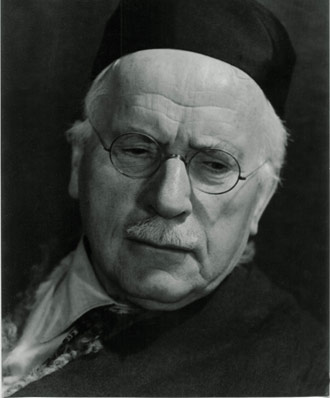
Gustav Jung (1875 to 1961) was a Swiss psychiatrist and
close colleague of Dr Sigmund Freud. Jung broke from the Freudian
psychoanalysis school of thought, over the issue of the unconscious mind as a
reservoir of repressed sexual trauma which causes all
neuroses. Jung founded his own school of analytical
psychology. Jung's
 approach to
psychology has been influential in the field of depth
psychology and in countercultural movements across the
globe.
approach to
psychology has been influential in the field of depth
psychology and in countercultural movements across the
globe.
Jung is considered as the first modern psychologist
to state that the human psyche is "by nature religious" and
to explore it in depth. He emphasized understanding the
psyche through exploring the worlds of dreams, art,
mythology, religion and philosophy. Although he was
a
theoretical psychologist and practicing clinician, much of
his life's work was spent exploring other areas, including
Eastern and Western philosophy, alchemy, astrology,
sociology, as well as literature and the arts. His most
notable ideas include the concept of psychological
archetypes, the collective unconscious and most notably the
phenomenon known as synchronicity.
Synchronicity
Jung created the
term synchronicity to describe the alignment of "universal forces"
within the life experiences of an individual. Jung hypothesized that
many experiences perceived as coincidences were not
merely due to chance, but instead reflected an ineffable
alignment or connection of such forces, within the
individual. Jung's belief was that, just as events may
be connected by causality, they may also be connected by
meaning. Events connected by meaning need not have an
explanation in terms of causality. This contradicts the
Axiom of Causality in specific cases but not generally.
Synchronicity implies that events are "meaningful
coincidences" ...if they occur with no causal
relationship, yet seem to be meaningfully related. Jung
defined synchronicity as an "acausal connecting
principle" or as "acausal parallelism." He
introduced the concept as early as the 1920s but gave a
full statement of it only in 1951 in an Eranos lecture.
Jung used the concept to address such phenomena as
paranormal and/or psychic ability or perception.
The process of becoming
intuitively aware and acting in harmony with these forces is
what Jung labeled "individuation". Jung said that an
individuated person would actually shape events around them
through the communication of their consciousness with the
collective unconscious.
Jung coined the term
“collective unconscious” to refer to that part of a person's
unconscious which is common to all human beings, as opposed
to personal unconscious, which is unique to each individual.
According to Jung the collective unconscious contains
archetypes, which are forms or symbols that are manifested
by all people in all cultures. The concept of collective
unconscious relates to the Spiritual model of living beings
consisting of individuated parts of Spirit encased in
physical form...
Like an island in the sea we appear as
distinct individuals, but beneath the surface we are all
connected.
Archetypes
According to Jung's
interpretation, archetypes are innate prototypes for ideas,
which may subsequently become involved in the interpretation
of observed phenomena. A group of memories and
interpretations closely associated with an archetype is
called a complex, and may be named for its central archetype
(e.g. "mother complex"). Jung often seemed to view the
archetypes as sort of psychological organs, directly
analogous to our physical, bodily organs: both being
morphological givens for the species; both arising at least
partially through evolutionary processes.
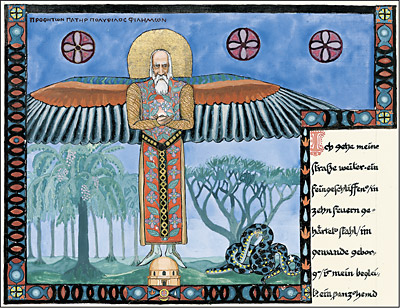 There are four famous
forms of archetypes numbered by Jung:
There are four famous
forms of archetypes numbered by Jung:
-
The
Self -
the unification of
consciousness and unconsciousness in a person, and
representing the psyche as a whole.
-
The Shadow -
every
manifest part of ourselves has a
repressed and
opposite counterpart, represented by the shadow.
-
The Anima -
feminine
principal, a young
lady, representing intuitive wisdom.
-
The Animus -
the
masculine principal, a handsome young man,
representing active, assertive energy.
The symbols of the
unconscious abound in Jungian psychology, eg: The Syzygy
(Divine Couple), The Child, The Superman, The Hero, The
Great Mother (manifested either as the Good Mother or the
Terrible Mother), The Wise Old Man, The Trickster or Ape.
Jung’s archetypes relate to the concept of occult symbols,
ie ideas and images that have become charged with
significance through aeons of reflection and veneration now
standing ready to release their potential upon invocation.
For example, Jung interpreted the Ouroboros or the snake
biting its own tail, as having an archetypical significance
to the human psyche. The Jungian psychologist Erich Neumann
writes of it as a representation of the pre-ego "dawn
state", depicting the undifferentiated infancy experience of
both mankind and the individual child.
"There are no
longer any gods whom we can invoke to help us.
The great religions of the world suffer from
increasing anaemia because the helpful
numina have fled from the woods, rivers,
mountains, and animals, and the God-men have
disappeared underground into the unconscious.
There we suppose they lead an ignominious
existence among the relics of the past, while we
remain dominated by the great Déesse Raison, who
is our overwhelming illusion."
 "We are so captivated by and entangled in our
subjective consciousness that we have simply
forgotten the age-old fact that God speaks
chiefly through dreams and visions."
"We are so captivated by and entangled in our
subjective consciousness that we have simply
forgotten the age-old fact that God speaks
chiefly through dreams and visions."
"Whatever else the unconscious may be, it is
a natural phenomenon that produces symbols, and
these symbols prove to be meaningful."
"At a time when all available energy is spent
in the investigation of nature, very little
attention is paid to the essence of human-kind,
which is psyche, although many researches are
made into its conscious functions. But the
really unknown part, which produces symbols, is
still virtually unexplored. We receive signals
from it every night (Dreaming), yet deciphering
these communications seems to be such an odious
task that very few people in the whole civilized
world can be bothered with it. Humankind's
greatest instrument, psyche, is little thought
of, if not actually mistrusted and despised.
This modern
standpoint is surely one-sided and unjust. It
does not even accord with the known facts. Our
actual knowledge of the unconscious shows it to
be a natural phenomenon, and that, like nature
herself, it is at least neutral. It contains all
aspects of human nature... light and dark,
beautiful and ugly, good and evil, profound and
silly. The study of individual as well as
collective symbolism is an enormous task, and
one that has not yet been mastered. But at last
a beginning has been made. The results so far
gained are encouraging, and they seem to
indicate an answer to many of the questions
perplexing present-day humankind."
- Carl Jung