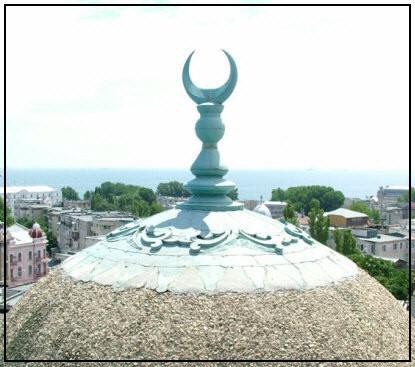
Islam is a
monotheistic Abrahamic religion originating with the teachings of the
Islamic prophet Muhammad, a 7th century Arab religious and political
figure. The word Islam means "submission", or the total surrender of
oneself to God. An adherent of Islam is known as a Muslim, meaning "one
who submits [to God]". The word Muslim is the participle of the same
verb of which Islām is the infinitive. There are between 1 billion and
1.8 billion Muslims, making Islam the second-largest religion in the
world, after Christianity.
Muslims believe that God revealed the Qur'an to
Muhammad, God's final prophet, through the angel Gabriel, and regard the
Qur'an and the Sunnah (words and deeds of Muhammad) as the fundamental
sources of Islam. They do not regard Muhammad as the founder of a new
religion, but as the restorer of the original monotheistic faith of
Abraham, Moses, Jesus, and other prophets. Islamic tradition holds that
Jews and Christians distorted the revelations God gave to these prophets
by either altering the text, introducing a false interpretation, or
both. - from Wikipedia

Tasawwuf
Sufism or tasawwuf, as it is called in Arabic, is
understood by scholars to be the mystical dimension of Islam.
Sufism began as religious teachers in
the Middle East came to
learn the Truth of Islam directly from Mohammad. Masters who were
“ordained” directly by Mohammad founded three major Sufi schools or
orders. The most essential mystical knowledge was then passed down from
each master to a disciple selected to follow as the leader of the
school. Other disciples were sent out as masters to establish new
schools. A Sufi school (ashram or convent) is often a community center
that may include a residence for the students and master, a school,
hospital, orphanage or any number of community services. Some of these
services may be very modest and others may be very extensive, but they
are often a vital part of the local community.
Schools are sometimes set
up near the tomb of a Sufi saint in order to maintain the shrine and
provide services to pilgrims, including places to retreat and meditate.
 While mainstream Islam promotes community service, mosques rarely
umbrella such services beyond theological schools since mainstream Islam
distinguishes the needs of the spirit from the needs of the body.
While mainstream Islam promotes community service, mosques rarely
umbrella such services beyond theological schools since mainstream Islam
distinguishes the needs of the spirit from the needs of the body.
There is no firm historical source for Sufism. Many of the early orders
were considered an integrated part of Islam, but as teachings were
codified and the elements of Shi’i and Sunni Islam became more distinct,
Sufism emerged with an identity. One of the basic ideas of Sufism is to
minimize the self or individual identity. Belonging to a particular
group with a unique name is contradictory to this effort. It is said, “a
Sufi is one who is not,” and with a philosophy that seeks the
destruction of self-identity it is thought that Sufi’s received their
name from outsiders. Initially the term Sufi referred only to those who
had achieved God realization, but it has since come to be applied to
anyone who follows that particular spiritual path.
While Sufism did not exist prior to Islam, Sufi doctrine contains many
elements that go beyond the teaching of Mohammad. Islam is an external
structure in which the individual exists while the internal quest for
enlightenment belongs to a realm of Sufi knowledge. This knowledge
integrates Islam and ancient doctrine that resembles elements of Greek
Philosophy, Zoroastrianism and Hinduism that are part of the Sufi path
to God-realization.
The most sacred knowledge of the Sufi masters is not
written and is passed to each generation orally, which makes it somewhat
difficult to historically trace the evolution of Sufi doctrine.
Nonetheless, it seems reasonable that the Sufi doctrine that differs the
most from the rest of Islam had its beginnings much earlier (although
this is a very non-Muslim view of Sufism). For many years these extra
qualities created a great deal of friction between mainstream Islam and
the Muslim mystics. After centuries of falling in and out of favor,
Sufis became integrated and an important central part of Islamic culture
and society.
A cornerstone of mysticism is that true knowledge of God is achieved
directly and not through an intermediary like a prophet, saint or
priest. Over the centuries this has led to a great deal of political
conflict between mystics and non-mystics. If a cleric or Priest behaves
or commands something that seems in conflict with dogma, the individual
is not in a position to disagree as long as there is no direct
relationship between God and the individual.
Many Sufi orders encourage honoring Saints and Prophets by visiting them
if the are alive or their tombs if they have passed on. Pilgrims often
will go to ask for favors in the form of miracles or prosperity. In many
communities the pilgrims are people from other religions who come to the
tombs in hopes of finding favor or receiving miracles.
The high status afforded saints in communities influenced by Sufism
implies an alternative means to communicate with God other than through
the Imam, the Islamic clerics. In a fundamentalist Islamic community the
highest-ranking Imam is the supreme authority, both politically and
religiously. Sufism presents a potential conflict to this authority
that has over the centuries led to persecution of Sufis in several Arab
countries. Saudi Arabia and Iran are two countries where the tombs of
Sufi saints have been destroyed. In some areas teachings of the Sufi
masters are held in high regard, yet practicing Sufism is discouraged or even
criminalized.
- David Berry
Training In Sufism
The life of a Sufi is the "life of the spirit "
regulated strictly in accordance with Islamic theology and
traditions. To attain this his first lesson is unshakable
belief in the existence of God and unconditional surrender
to His will. This entails a strenuous life attended by rigid
austerity and self-denial. The Sufi has to undergo a course
of training in regular prayers and meditation to attain the
Divine Knowledge and realisation of Truth. This particular
knowledge is passed on 'in secret' by one Sufi to
another having the requisite qualifications (i.e. one who
does not think evil does not see evil, does not hear evil
and does not speak evil). Without this Divine Knowledge, one
cannot fathom the hidden mysteries of the Nature and those
of the soul. To sum up the whole ob ject of Sufism is to
attain the highest spiritual perfection.
ject of Sufism is to
attain the highest spiritual perfection.
When a seeker decides to become a mystic or Sufi,
they are expected to go to a Sheikh or Murshid (master) and spend with
him as much time as is deemed necessary by the Sheikh for his
spiritual development. During this period of apprenticeship
which, in most cases lasts a lifetime, the Sheikh instructs the
disciple to perform tasks of servitude so as to gain control
over his appetitive soul. This is done by performing service
like hewing of wood, drawing of water from the wells and so many
other menial services in the Khanqah (the monastery or chapel).
Even Hazrat Khawaja Muinuddin Chishty himself had to pass
through this hard and rigorous course of probation when he was
under training for a period of 20 years with his Pir-o-Murshid
(master) Hazrat Khawaja Usman Harooni. Every Sufi saint has to
perform these hard services for his 'Pir' before achieving the
robe of Khilafat (succession).
Stages Of Mysticism
According to the Islamic standard of judgment, the seeker
after Truth, as stated above has to pass through many stages
before he can actually feel himself in commination with the
Truth being the ultimate object. The elementary condition is to
have an unshakable faith and a firm resolve in doing or not
doing a thing that is termed 'niyyat' (intention) in Muslim
theology which is followed by repentance and penitence. The next
stage is called "Mujaheda" (probation of striving). When it
reaches its zenith then the revelation process begins which is
known as "Mukashfa" (the uplifting of veil). At this stage the
attainments of the saint (or Sufi) are so exquisite that he
merges his identify in the will of God, the creator. The effort
by which each stage is gained is called 'haal' (state). It is a
state of joy or desire and when the seeker is in this condition
he falls into 'wajd' (ecstasy).
Sufi Symbolism
The
Sufis believe that the
phenomenal world is the Unreal,
that the reason men are blind to
the existence of the Real world,
which is the Spiritual, is
because there are veils and
mists separating the soul from
God. This world appears
Real to the man who
cannot use his spiritual eye and
view the Beyond. Having no
discernment of the Unseen, he
does not believe in its
existence. But whosoever becomes
aware of the Divine Light
shining in the heart, and who
realizes the love of God in the
soul, is able to pass from the
Unreal to the Real; he will see:
"Gold wherever we go, and pearls
Wherever we turn, and silver in
the waste."
So exquisite is the vision of
the All-Beautiful that whoever
has had this vision instantly
becomes enamored, and leaves the
world of shadows and change to
contemplate the One. He will not
rest until he has purified his
life, cast aside everything that
may be a hindrance in his path,
and he will spend his whole life
in communion with God, at the
same time pouring out in
love-songs and praise all the
worship and adoration of his
soul.
In reading the enraptured
poetry of the Sufi's, it should be
borne in mind that, though the
symbols of earthly love and beauty
are freely used, yet the real
meaning is concealed. No doubt this
was originally done to keep secret
their mystic love, lest the profane
should scoff. But as time went on
certain words began to have a
recognized meaning amongst
themselves. For instance:
EMBRACES and KISSES are
raptures of love.
SLEEP is contemplation,
PERFUME the wish for Divine favor.
IDOLATERS mean men of the pure
faith, not infidels.
WINE, which is strictly
forbidden in Islam, was used as a
word-symbol by the Sufi's to denote
spiritual knowledge,
and the WINE-SELLER means the
spiritual guide.
A TAVERN is a place where the
wine of Divine love inebriates the
pilgrim.
INTOXICATION means religious
ecstasy, MIRTH the joy in the love
of the Deity.
BEAUTY means the glory of the
Beloved.
CURLS and TRESSES mean
plurality veiling the face of Unity
from its lovers.
The CHEEK means Divine essence
of names and qualities.
The DOWN is the world of pure
spirits which is nearest to
Divinity.
The MOLE on the cheek is the
point of indivisible Unity.
The TORCH is the light kindled
in the heart by the Beloved.
- from Khwaja Gharib Nawaz's
Website