Sanātana Dharma
Hinduism is
a religious tradition that originated on the Indian subcontinent. Hindus themselves prefer to use
the Sanskrit term Sanātana Dharma for their religious tradition. Sanātana
Dharma is often translated into English as “eternal tradition” or “eternal
religion” but the translation of dharma as “tradition” or “religion” gives
an extremely limited, even mistaken, sense of the word. Dharma has many
meanings in Sanskrit, the sacred language of Hindu scripture, including
“moral order,” “duty,” and “right action.”
Dharma is an all-important concept
for Hindus. In addition to tradition and moral order, it
also signifies the path of knowledge and correct action.
Because of Hinduism’s emphasis on living in accordance with
Dharma, anyone who is striving for spiritual knowledge and
seeking the right course of ethical action is, in the
broadest sense, a follower of Sanātana Dharma. Within
the context of Hinduism, Dharma refers to one's personal
obligations, calling and duties, and a Hindu's Dharma is
affected by the person's age, caste, class, occupation, and
gender. In modern Indian languages it can refer simply to a
person's religion, depending on the context.
Hinduism is one of Earth's most
ancient and revered traditions, perhaps the oldest living
religion on the planet.
History
The earliest
evidence for prehistoric religion in India date back to the late
Neolithic in the early Harappan period (5500–2600 BCE). The
beliefs and practices of the pre-classical era (1500–500 BCE)
are called the "historical
Vedic religion". The Vedic religion shows influence by
Proto-Indo-European religion. Modern Hinduism grew out of the
Vedas, the oldest of which is the
Rig Veda, dated to 1700–1100 BCE. The Vedas center on
worship of deities such as Indra, Varuna and Agni, and on the
Soma ritual. Fire-sacrifices, called yajña were performed,
and Vedic mantras chanted but no temples or idols are known.
The major Sanskrit epics, Ramayana and Mahabharata, were
compiled over a protracted period during the late centuries BCE
and the early centuries CE. They contain mythological stories
about the rulers and wars of ancient India, and are interspersed
with religious and philosophical treatises. The later Puranas
recount tales about devas and devis, their interactions with
humans and their battles against mythological humanoid beings,
or rakshasa.
Hindu Texts
Hinduism’s vast body of scriptures include: the
Vedas and the
Upanishads , which are considered to be the foremost in
authority, importance and antiquity. There are four Vedas,
the Rig Veda, Sama Veda, Yajur Veda and Atharva Veda. The
Vedas are the primary texts of Hinduism. They contain hymns, incantations,
and rituals from ancient India. They also had a vast
influence on Buddhism, Jainism, and Sikhism. Traditionally
the text of the Vedas was coeval with the universe. Scholars
have determined that the Rig Veda, the oldest of the four
Vedas, was composed about 1500 BCE, and codified about 600
BCE. It is unknown when it was finally committed to writing,
but this probably was at some point after 300 BCE.
 The Upanishads are a continuation of the Vedic
philosophy, and were written between 800 and 400 BCE. They
elaborate on how the soul (Atman) can be united with the
ultimate truth (Brahman) through contemplation and
mediation, as well as the doctrine of Karma-- the cumulative
effects of a persons' actions.
The Upanishads are a continuation of the Vedic
philosophy, and were written between 800 and 400 BCE. They
elaborate on how the soul (Atman) can be united with the
ultimate truth (Brahman) through contemplation and
mediation, as well as the doctrine of Karma-- the cumulative
effects of a persons' actions.
In the Rig Veda, the belief (or observation) that a
natural justice and harmony pervades the natural world becomes
manifest in the concept of
rta, which is both 'nature's way' and
the order implicit in nature. Thus rta bears a resemblance to
the ancient Chinese concept of Tao and the Christian conception
of the logos. This "power" that lies behind nature and that
keeps everything in balance became a natural forerunner to the
idea of dharma. The idea of rta laid the cornerstone of dharma's
implicit attribution to the "ultimate reality" of the
surrounding universe.
The transition of the rta to the modern idea of
dharma occurs in the Brihadaranyaka Upanishad. The
Upanishads saw dharma as the universal principle of law,
order, harmony, all in all truth, that sprang first from
Brahman. It acts as the regulatory moral principle of the
Universe. It is sat (truth), a major tenet of
Hinduism. This hearkens back to the conception of the Rig
Veda that "Ekam Sat," (Truth Is One), of the idea that
Brahman is "Sacchidananda"
(Truth-Consciousness-Bliss). Dharma is not just law, or
harmony, it is pure Reality.
Other major scriptures
include the
Tantras, the Agama and the
Bhagavad Gītā, a treatise from the Mahābhārata, spoken
by Krishna, is sometimes called a summary of the spiritual
teachings of the Vedas.
Trimurti - The Hindu Trinity
The Trimurti is a concept in Hinduism in which
the cosmic functions of creation, maintenance, and destruction are
personified by the forms of Brahma the creator, Vishnu the maintainer
or preserver, and Shiva the destroyer or transformer. These three
deities have been called "the Hindu
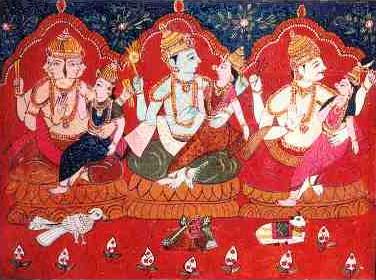 triad" or the "Great Trinity". They
are also aligned as: The transcendent Godhead - Shiva... the cosmic lord
- Vishnu... and the cosmic mind - Brahma. In this regard they are called
Sat-Tat-Aum, the Being, the Thatness or immanence and the Word or
holy spirit. This is much like the Christian trinity of God as the
Father, Son and Holy Ghost. The trinity represents the Divine in its
threefold nature and function. Each aspect of the trinity contains and
includes the others.
triad" or the "Great Trinity". They
are also aligned as: The transcendent Godhead - Shiva... the cosmic lord
- Vishnu... and the cosmic mind - Brahma. In this regard they are called
Sat-Tat-Aum, the Being, the Thatness or immanence and the Word or
holy spirit. This is much like the Christian trinity of God as the
Father, Son and Holy Ghost. The trinity represents the Divine in its
threefold nature and function. Each aspect of the trinity contains and
includes the others.
Each God in the trinity has his consort. To
Brahma is Saraswati, the Goddess of knowledge. For Vishnu is Lakshmi,
the Goddess of love, beauty and delight. For Shiva is Kali, the Goddess
of power, destruction and transformation. These are the three main forms
of the Goddess, as Brahma, Vishnu and Shiva are the three main forms of
the God. The three Goddesses are often worshipped in their own right as
well as along with their spouses.
Ananta Shesha
In Hindu (Vedic) tradition, Shesha (Shesha
the Naga) is the king of all
nagas, one of the primal beings of creation,
and according to the Bhagavata Purana, an Avatar
of the Supreme God known as Sankarshan. Shesha
is generally depicted
 with
a massive form that floats coiled in space, or
on the universal ocean, to form the bed on which
Vishnu lies. Shesha is depicted as a many
thousand-headed serpent, sometimes with each
head wearing an ornate crown.
with
a massive form that floats coiled in space, or
on the universal ocean, to form the bed on which
Vishnu lies. Shesha is depicted as a many
thousand-headed serpent, sometimes with each
head wearing an ornate crown.
In the Puranas, Shesha is said
to hold all the planets of Universe on his hoods and to
constantly sing the glories of Vishnu from all his mouths. He is
sometimes referred to as Anantha Shesha which means endless
Shesha or as Adishesha which means the first Shesha. It is said
that when Adishesha uncoils, time moves forward and creation
takes place. When he coils back, the universe ceases to exist. "Shesha"
also means remainder: that which remains when all else ceases to
exist.