Cyberpunk 1.0
The
last quarter of the 20th century set the stage for the
Brave Noö World we all have
inherited. The socio-economic and para-political gyrations that
came to fruition in the eighties and nineties laid the
foundation for the 21st century’s autocratic turmoil. There were
however, literary and cinematic indicators that provided fair
warning...
The
close of the 20th century also provided us with a visionary and
prophetic sub-genra of science fiction that came to be known as
“Cyberpunk.” Cyberpunk’s dystopian themes of gritty
cityscapes, climate collapse, unbridled corporatocracy and
unleashed Artificial Intelligences, have proven especially
prophetic in today’s dystopian reality.
Cyberpunk
didn’t spring fully formed from the head of William Gibson like
some chrome-plated Athena. Its DNA can be traced back to the
noir-tinged science fiction of the 1960s and ’70s. Authors like
Philip K. Dick were already exploring the dark underbelly of
technological progress in novels like “Do Androids Dream of
Electric Sheep?”
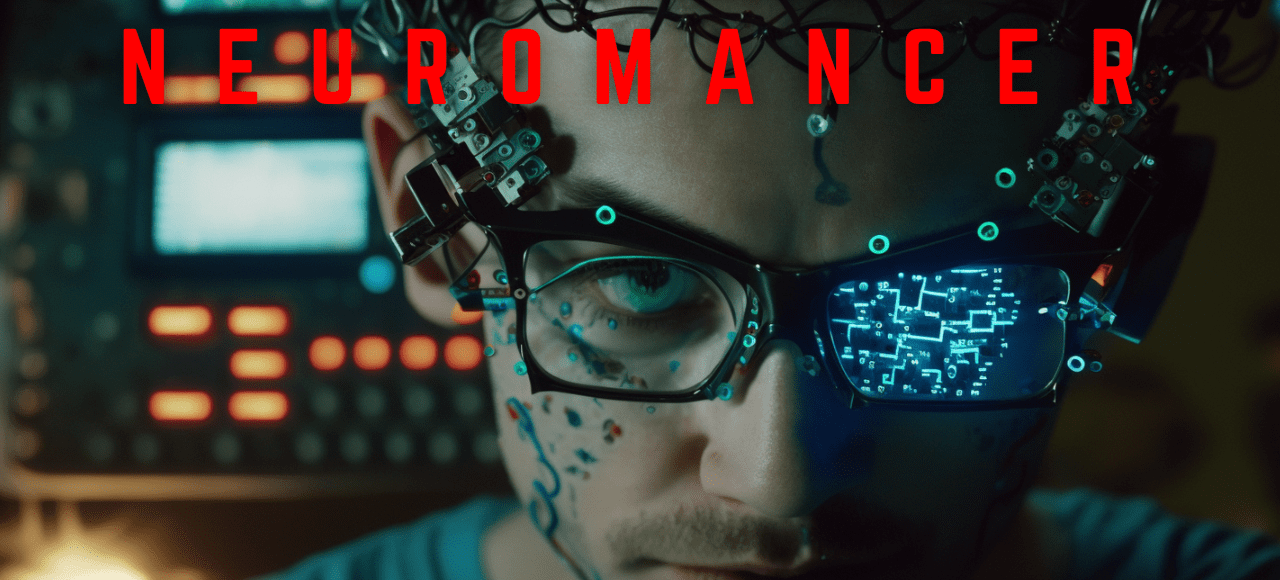
William Gibson
first published his now-classic dystopian Science Fiction novel,
“Neuromancer”
in 1984. This year was a very prophetic and ominous year,
especially for dystopian tomes, as it was the very year that
another novelist, George Orwell… set as democracy’s expiration
date, in his novel…
Nineteen Eighty-Four.
“As literary
political fiction and dystopian science-fiction, Nineteen
Eighty-Four is a classic novel in content, plot, and style. Many
of its terms and concepts, such as Big Brother, doublethink,
thoughtcrime, Newspeak, Telescreen, 2 + 2 = 5, and memory hole,
have entered everyday use since its publication”
- Wikipedia.
Orwell’s work,
published in 1949, was of course the granddaddy of all modern
dystopian tales. Orwell’s novel, and its infamous character, the
global party leader: “Big
Brother” …reflected collective fears emerging from
post-WWII, of... unbridled Nationalism, the rise of the
Military-Inductrial Complex, censorship and mass surveillance.
And of course, as in all good Sci Fi, Nineteen Eighty-Four
served as a
cautionary tale of an unpredictable, dangerous future.
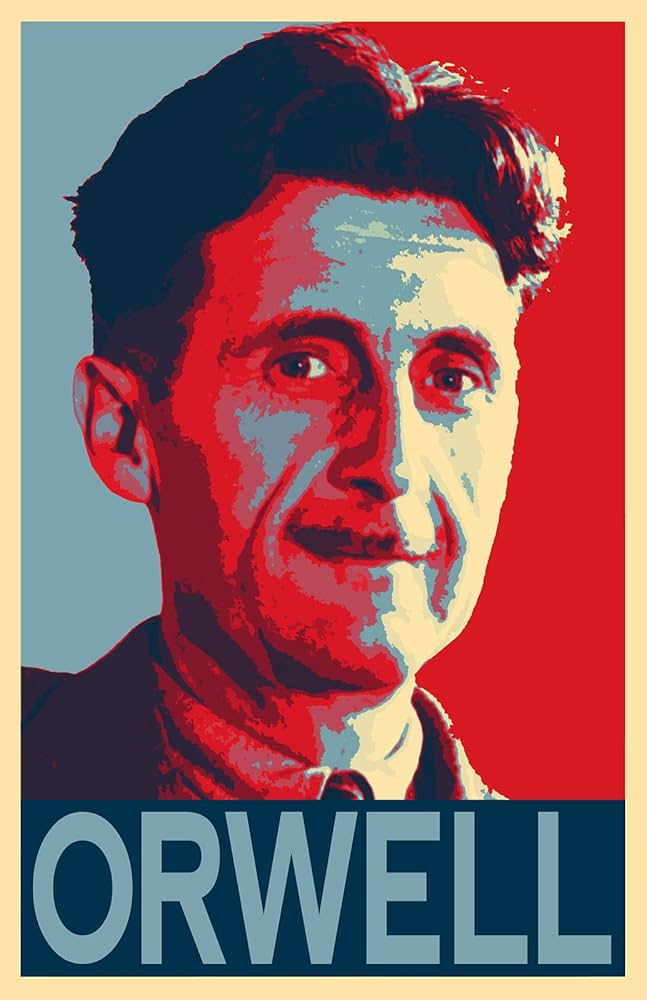
Since its
publication, “1984” has stood the test of time, to become
the definitive work on dystopia. It continues to have relevance
today, particularly for its examination of global government
surveillance and the effect it visits upon the novel’s
population.
Gibson’s
Neuromancer has been credited for establishing
“Cyberpunk” as a literary genre, and as being the
archetypical cyberpunk novel. It appears that, like Orwell’s
“1984,” Gibson’s “Neuromancer” is destined to become
the definitive work on the new (and improved!) dystopian
narrative.
Neuromancer
explores a dystopic near future where a handful of powerful
families, via their manifold mega-corporations, security firms,
paramilitary and artificial intelligences, control the planet
and its off-world stations. Neuromancer also presents the
reader with the archetypical “console cowboy” or computer
hacker... the quintessential cyberpunk, possessing singular
talent and wondrous technologies. It is the cyberpunk, either
alone or in legion, who wage virtual war against “the
machine” or the machinations of the powerful
predator/dominator elite.
Interestingly, cyberpunk is a word coined by
Gardner Dozois, the science fiction writer and past editor
of Asimov's Science Fiction magazine, to describe the fiction of
William Gibson. The term went viral in the late 1980’s
and early 1990’s, to become the definitive cultural icon of the
emerging information age. The term has fallen in and out of
favor in the twenty-first century, as being, now dated &
clique... now, fearfully fitting & poignant.
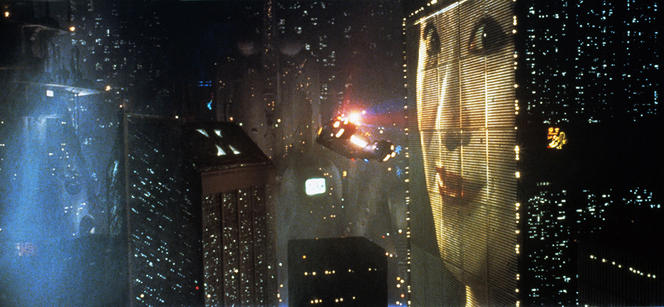
Two years prior to
the publication of Neuromancer, a science fiction film
directed by Ridley Scott, introduced world audiences to the
visually stunning, proto-cyberpunk classic:
Blade Runner. Starring Harrison Ford, Rutger Hauer, Sean
Young, and Edward James Olmos, Blade Runner is an
adaptation of
Philip
K. Dick's 1968 novel Do Androids Dream of Electric Sheep?
The
film is set in a dystopian future (now past) Los Angeles of
2019, in which synthetic humans known as replicants are
bio-engineered by the powerful Tyrell Corporation to work on
space colonies. When a fugitive group of advanced replicants led
by Roy Batty (played by Hauer) escapes back to Earth, former cop
Rick Deckard (played by Ford) reluctantly agrees to hunt them
down.
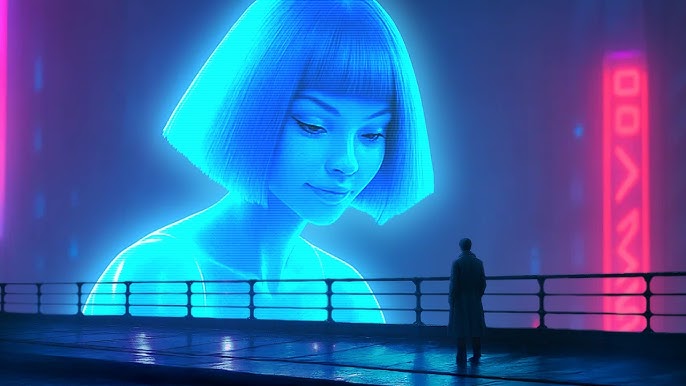
“Two
years before Neuromancer, Blade Runner had already established
the definitive visual aesthetic of cyberpunk cinema. The film’s
depiction of a perpetually rain-soaked, neon-saturated,
multicultural Los Angeles became the indelible image of the
cyberpunk future. Its towering ziggurats, flying vehicles
(“spinners”), and streets teeming with a polyglot humanity
created a world that was both technologically advanced and
deeply decayed.
This visual
language was so powerful and pervasive that Gibson, upon seeing
the film midway through writing Neuromancer, famously worried
that audiences would assume he had simply copied its “fine
visual texture”. While both works drew from a shared well of
influences, including
Métal Hurlant, Blade Runner provided the visual blueprint
that would define the genre for decades.”
-
Retrofuturista

Cyberpunk 2.0
In a classic example of life
imitating art, the next generation of cyberpunk has been
exemplified by none-other than… Anonymous.
The
Anonymous Collective
is a loosely associated international network of activist and
hacktivist entities. Collectivly, they/it represent the first
globally operational generation of cyberpunk. Established in
2003,
Anonymous
saught mass awareness and revolution against what the collective
perceives as corrupt entities… while attempting to maintain
anonymity.
This brief history of Anonymous was taken from
Wikipedia…
According to white supremacist radio host Hal Turner, in
December 2006 and January 2007 individuals who
identified themselves as Anonymous took Turner's
website offline, costing him thousands of dollars in
bandwidth bills. As a result, Turner sued 4chan,
eBaum's World, 7chan, and other websites for copyright
infringement. He lost his plea for an injunction,
however, and failed to receive letters from the court,
which caused the lawsuit to lapse.
On
January 14, 2008, a video produced by the Church
of Scientology, featuring an interview with Tom
Cruise was leaked to the Internet and uploaded to
YouTube. The Church issued a copyright violation claim
against YouTube requesting the removal of the video. In
response to this, Anonymous formulated Project
Chanology... calling the action by the Church of
Scientology a form of Internet censorship.
On
January 21, 2008, individuals claiming to speak for
Anonymous announced their goals and intentions via a
video posted to YouTube entitled "Message
to Scientology," and a press release declaring a
"War on Scientology" against both the Church of
Scientology and the Religious Technology Center. In the
press release, the group states that the attacks against
the Church of Scientology will continue in order to
protect the right to freedom of speech, and end what
they believe to be the financial exploitation of church
members.
On
February 10, 2008, about 7000 people protested in more
than 93 cities worldwide. Many protesters wore masks
based on the character V from V
for Vendetta (who, in turn, had been influenced by
Guy Fawkes), or otherwise disguised their identities, in
part to protect themselves from reprisals from the
Church.
It
was these actions taken against the Church of
Scientology that brought world-wide notoriety to
Anonymous. In the ensuing years, Anonymous has ebbed and
flowed in its recognition and effectiveness. However, it
is its very amorphous nature that allows Anonymous to
thrive in our contemporary, over-mediated information
age. It is precisely this de-centralized, spontaneously
plural disorganization that befuddles law enforcement,
in their attempts to “neutralize” or for that matter, to
even understand Anonymous.
How fast are you? How dense?
Cyberpunk is curious. Cyberpunk is
tenacious. Cyberpunk is resilient. These are essential qualities
of survival for the twenty-first century. The ability to
retrieve (read: hack) and interpret (analyze) information is
vital in navigating the modern world. It is in the
interpretation of data that the cyberpunk’s survivability and
opportunity resides. Deep thinking and the ability to
“connect the dots” is what keeps the cyberpunk one step
ahead of the machine.
This
is where the true value of cyberpunk dwells... critical thinking
and the ability to convey intricate and complex information in a
concise format. This is the power of poetry… relating complex
intellectual and emotional content in an articulate manner.
Poetic imagery is dense. It imparts a lot of information, in few
words.
“What’s good about
cyberpunk is that it’s fast and dense. It has a lot of
information. If you value information the most, then you don’t
care about convention. It’s not, “Who do you know?” …it’s “How
fast are you? How dense?” It’s not, “Do you talk like my old
friends?” …it’s “What do you have to say?” It’s not, “Is this
comfortable?” …it’s “Is this interesting?”
-
Rudy
Rucker
Cyberpunk 3.0
...is poised to
impact our world in a big way. Whether it will take the form of
the ever re-spawning
Anonymous Collective, or assume a new, as-yet
unrecognized form… get ready. Cyberpunk is the response… the
first line of defense… to the systems of control, the
predator/dominator culture… the machine. The creativity and
resilience of cyberpunk is quite likely the “agent of change”
that will act as a catalyst of evolution. It may be that
cyberpunk was “sent here” from from the future... from
who knows where… to save our sorry ass.
…for Cyberpunk is
also a changeling... a quick-change artist. Cyberpunk morphs as
needed and stands upon the fulcrum point of societal change. The
next generation of cyberpunk is about to hit the “execute”
button. As we all know, change occurs at an exponential rate in
our modern world. Change is the one constant in Universe... it
is the one thing we can truly count on. And as we all know…
“In an evolving
universe, he who stands still… moves backward.”
BigTime tv Home